
After 12 years as a PADI divemaster across three oceans, I've watched hundreds of nervous first-timers turn into confident divers in a single week. This guide is the complete walkthrough I wish someone had handed me before my first breath underwater — covering certification, costs, gear, safety, and your first real dives.
What Is Scuba Diving, Really?
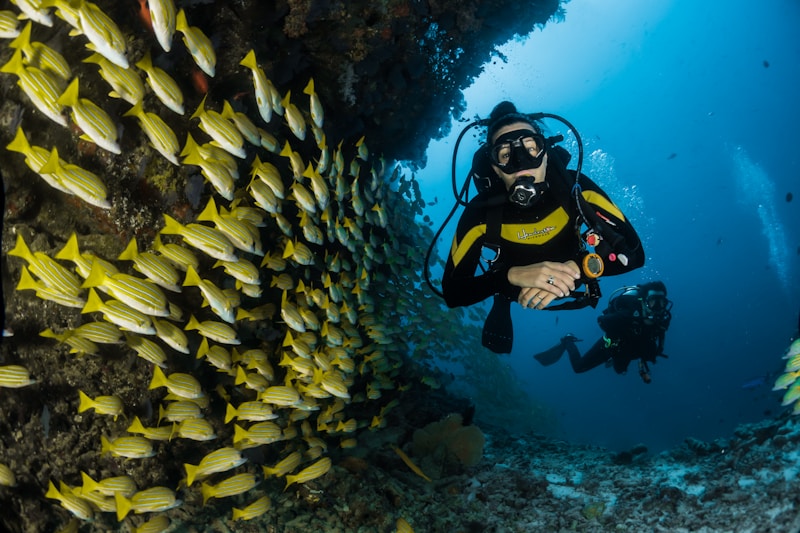
Scuba — Self Contained Underwater Breathing Apparatus — lets you stay submerged for 40 to 70 minutes at a stretch using compressed air carried on your back. Unlike snorkeling, you swim at depth, equalize your ears as you descend, and float weightlessly through three-dimensional space. Recreational diving is capped at 40 metres (130 feet), but most beginners spend their first dives between 5 and 18 metres where the light is best, the colours are still rich, and the marine life is astonishingly active.
Modern recreational scuba is one of the safest adventure sports going. The Diver Alert Network's annual report consistently shows fewer fatalities per 100,000 participants than skiing, mountain biking, or even horseback riding. Almost every incident traces back to skipping training, ignoring a buddy check, or pushing past personal limits — all things you control.
Are You Physically Ready to Dive?
Most healthy people aged 10 and up can dive. You'll fill out a medical questionnaire before any course, and a "yes" to anything serious means a quick sign-off from a doctor. The big disqualifiers are uncontrolled asthma, recent ear surgery, certain heart conditions, and pregnancy. If you can swim 200 metres without stopping and float for 10 minutes, you'll pass the watermanship check easily.
Common Concerns I Hear at Pre-Dive Briefings
- "I'm claustrophobic." Open water diving is the opposite of claustrophobic — you're floating in vast space. The mask is the only enclosed bit, and instructors have a quiet routine for getting you comfortable with it.
- "My ears never equalize on planes." Diving equalization is active and gentle (Valsalva or Frenzel). 95% of plane-ear sufferers do fine.
- "I'm a weak swimmer." You won't be racing anyone. Slow, steady, fin-driven movement is the only style we use down there.
Choosing Your First Certification Agency
The big four are PADI, SSI, NAUI and RAID. They all certify you to the same global standard (RSTC/ISO 24801). Dive shops everywhere accept any of them — I've never seen a credential refused. Pick whichever school near you has the best instructor reviews, not the brand.
| Agency | Strengths | Best For |
|---|---|---|
| PADI | Largest network, found everywhere, polished materials | Travelers who'll dive in different countries |
| SSI | Free digital materials with shop, more flexible standards | Budget-conscious learners |
| NAUI | Strong academic depth, instructor-driven | Engineering minds who want the science |
| RAID | Modern, all-online theory, free re-certification | Tech-savvy students |
The Open Water Course: Step by Step
Your entry-level certification is the Open Water Diver. It's three to four days, costs USD 350-650 depending on country, and unlocks diving anywhere on Earth to 18 metres with a buddy.
Day 1 — Theory and Pool Skills
You'll watch videos, complete short knowledge reviews, and then move to a swimming pool or a calm shallow bay. The first 20 minutes underwater are the hardest minutes of your scuba career. Once you remember to keep breathing and stop thinking, the rest is easy.
Day 2 — More Pool, More Skills
Mask removal and replacement, regulator recovery, buoyancy fin pivot, controlled emergency swimming ascent. None of these are physically hard. They're rehearsal for problems you'll almost certainly never have.
Days 3-4 — Four Open Water Dives
Two dives a day in a real ocean, lake or quarry. Your instructor will run you through the same skills again, then let you simply dive for the back half of each session. This is where most people fall in love with the sport.
What Does It Cost to Become a Diver?
| Item | Budget Option | Premium Option |
|---|---|---|
| Open Water course | USD 350 (Thailand, Honduras) | USD 700 (Caribbean, Mediterranean resort) |
| Mask, snorkel, fins | USD 120 | USD 350 |
| Wetsuit (3mm) | USD 120 | USD 280 |
| Dive computer (entry level) | USD 200 | USD 500 |
| Logbook + insurance (DAN) | USD 60 | USD 110 |
| Total to certified diver | USD 850 | USD 1,940 |
You don't need the gear on day one. Every dive shop rents BCDs, regulators and tanks. I tell new students to buy only mask, fins and snorkel before their course — fitting your face is a personal thing.
Choosing Where to Get Certified
If you can travel, get certified in warm, clear, calm water. The skills go in your muscle memory faster when you can actually see what you're doing and you're not battling cold.
Best Beginner Destinations
- Koh Tao, Thailand — Cheapest in the world, 25-29°C water, hundreds of certified divers leave every week.
- Utila, Honduras — Caribbean reef, friendly to backpackers, USD 350 courses.
- Bonaire — Shore diving paradise, structured house reef, perfect for cautious starters.
- Maldives (resort packages) — Luxe end, but the ocean does the teaching for you.
- Cyprus / Malta — European-priced, no-current bays, English-speaking schools.
Essential Gear Explained
The Five Things Strapped to You Underwater
- Mask — air space for your eyes. Tight enough to seal, loose enough to feel comfortable for 60 minutes.
- Fins — open-heel with boots for cold water, full-foot for tropical.
- BCD (Buoyancy Compensator) — the inflatable jacket that holds your tank and lets you fine-tune your depth.
- Regulator — turns the high-pressure tank air into something your lungs can handle.
- Dive computer — tracks depth, time and nitrogen loading. The single most important piece of safety kit you'll ever own.
Underwater Communication and Buddy Diving
Sound doesn't travel well underwater, so divers use hand signals. Learn five before your course and you'll feel ahead of the curve: OK, problem, up, down, and air-low.
Always dive with a buddy. Even after a thousand dives I never break this. Your buddy hands you their alternate regulator if your tank fails, watches your back for that hammerhead behind you, and witnesses your reef shark encounter so you know it really happened.
Your First Real Dive: What It's Actually Like
You'll do a giant stride off the back of a boat. There's a moment of bubbles, then you bob up. You exchange OK signs with your buddy and instructor, dump the air from your BCD, and start a slow head-up descent down a line. Pinch your nose every metre and gently blow. The pressure on your ears releases.
By 8 metres the surface noise has gone. You hear your own breathing — slow, deep, hypnotic. You drift over a coral garden. A pufferfish stares at you from a metre away and doesn't move. A turtle eats sponge above your head. Time runs out impossibly fast. The instructor signals up, you do a 3-minute safety stop at 5 metres watching small jacks circle, and you surface buzzing.
Continuing Education After Open Water
- Advanced Open Water — five specialty dives including deep (30m) and night. Single biggest skill-jump in recreational diving.
- Enriched Air Nitrox — breathe 32% oxygen, get longer bottom times. A weekend course.
- Rescue Diver — the course every diver says changed how they think. Genuinely transformative.
- Specialties — wreck, drift, photography, cavern, sidemount. Pick what excites you.
Safety Rules I Live By
- Never hold your breath. The single absolute rule.
- Plan your dive, dive your plan.
- Ascend slowly — no faster than 9 metres per minute.
- Always do a 3-minute safety stop at 5 metres.
- Don't drink alcohol within 8 hours before diving.
- Don't fly within 18 hours of your last dive.
- If something feels wrong, abort the dive. Nobody will judge you.
Common Beginner Mistakes (and How to Avoid Them)
- Over-weighting — You don't need 8kg in tropical water. Ask for a proper weight check.
- Hand-paddling — Keep your arms folded. Fins do the work.
- Holding breath while ascending — Breathe constantly. Always.
- Skipping pre-dive safety check (BWRAF) — This 90-second routine catches almost every gear failure before it matters.
- Diving when sick — Congested ears + 10 metres of seawater = ruined holiday. Don't.
Marine Life You'll See Early On
Even in beginner depths the headline acts show up. Tropical reefs deliver parrotfish, butterflyfish, moray eels, octopus, hawksbill turtles and reef sharks within the first ten dives. Cold water sites bring kelp forests, wolffish, seals and sometimes orca. Don't chase wildlife — hover still and they come to you.
Sustainable Diving: Don't Be That Diver
- Master buoyancy before you go anywhere near coral.
- Streamline gauges and octos so nothing dangles and breaks reef.
- Don't touch, ever. Even gloved hands kill polyps and stress animals.
- Use reef-safe sunscreen (oxybenzone-free).
- Choose operators that mooring-buoy rather than anchor.
Ready to Get Started?
Book your first try-dive or full Open Water course through a vetted operator:
- PADI — find an Open Water course at a 5-star dive centre near you.
- GetYourGuide — single-day Discover Scuba experiences worldwide.
- Viator — beginner-friendly intro dives in 60+ countries.
Frequently Asked Questions
How long does scuba certification take?
The classic Open Water course is three to four full days: half a day of theory, a day of pool work, and two days of four open water dives. E-learning lets you finish theory at home and shorten the on-site portion to as little as two and a half days.
Is scuba diving dangerous for beginners?
Statistically no. With proper training, a buddy, and conservative depth limits, recreational diving has a fatality rate lower than driving a car for an hour a day. The risk almost always comes from skipping training, holding your breath, or diving beyond your level.
How deep can a beginner dive?
Open Water Divers are certified to 18 metres (60 feet). Once you complete the Advanced course you can go to 30 metres (100 feet), and full recreational depth is 40 metres (130 feet) with appropriate training.
Do I need to be a strong swimmer?
You need to swim 200 metres without stopping (any stroke, no time limit) and float or tread water for 10 minutes. That's it. There's no speed component and no diving in the water-test sense.
Should I buy or rent gear as a beginner?
Buy your mask, snorkel, fins and a dive computer. Rent everything else for your first 20 dives. Once you know what kind of diving you love (warm, cold, technical, photography) you can invest in the right BCD and regulator without wasting money.